
Practising Complexity
What does an art movement that began in the 1960s have in common with Complexity Management, an approach that surfaced in the 1980s, an application that evolved from Complex Adaptive Systems Theory?

Complex situations and relationships create uncertainty. When faced with a set complex, entangled challenges, many of us will have a strong desire to make sense, create order, and reduce complexity. Complexity Management Theory proposes the opposite, that we get comfortable with the unknowns and develop the capacity to meet complexity with complexity. Cultivating an environment that enables open dialogue, experimentation, and failure, to allow unexpected solutions to emerge.
My interest in complexity management does not emerge from a conventional management pathway, but from sustained engagement in the arts. Through my MFA practice, grounded in Fluxus, relational aesthetics, and social practice, I developed ways of working that, in retrospect, align closely with contemporary approaches to leading in complex environments.
Across these artistic traditions, the focus shifts away from producing fixed outcomes toward designing conditions for interaction, where meaning emerges through participation, context, and time. This orientation resonates strongly with frameworks such as the Cynefin framework and Complexity Leadership Theory, which recognise that in complex systems outcomes cannot be predicted or controlled in advance. Instead, leaders must enable adaptive responses through the careful structuring of environments.
During my Executive MBA, I have realised that my creative practice has functioned as a practical methodology for working with complexity. Rather than treating Fluxus and related movements as historical precursors to complexity leadership, I position them as parallel modes of practice that meet complexity with complexity. Through a case study of my MFA project I say a little prayer for you, I demonstrate how artistic processes translate directly into capabilities required for leadership in uncertain, interdependent contexts.
At the centre of this is a shift in role: from decision-maker to condition-setter, and ultimately to steward of a system in motion.
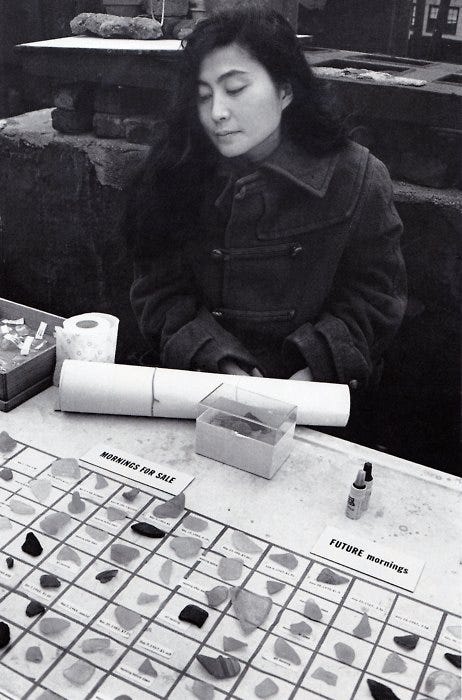
Morning Piece, Yoko Ono, 1964.
Fluxus, Relational Practice, and Social Practice
Fluxus emerged in the 1960s as a distributed network of artists who rejected the authority of the individual genius and the primacy of the art object. Its central proposition was the unity of art and life, where everyday actions were reframed as sites of creative and social meaning. Works were often structured through “event scores” - minimal instructions that invited interpretation and participation, rather than fixed outputs.
Relational aesthetics later formalised aspects of this shift, defining art as the production of social relationships rather than objects. Social practice extends this further, positioning interaction, dialogue, and collective experience as the primary medium. Across these approaches, the work is not something produced and presented, but something that unfolds through engagement.
What unites these practices is a shared emphasis on:
participation over authorship
process over product
interaction over representation
openness over control
These are not only artistic positions. They are organisational logics.
Convergence with Complexity Leadership
The organising principles of these practices align closely with contemporary approaches to complexity. In the complex domain, as described in the Cynefin framework, cause and effect can only be understood retrospectively, and outcomes emerge through interaction rather than planning. Similarly, Complexity Leadership Theory positions leadership as an emergent process occurring within networks, rather than a function of hierarchy.
This convergence can be understood through a set of shared principles:
Minimal structures enable adaptive behaviour (event scores / enabling constraints)
Agency is distributed across participants (collaboration / distributed leadership)
Learning occurs through iteration and response (play and chance / safe-to-fail experimentation)
Meaning emerges relationally (intermedia / interconnectivity)
Both domains respond to complexity not by simplifying systems, but by increasing their capacity to adapt.
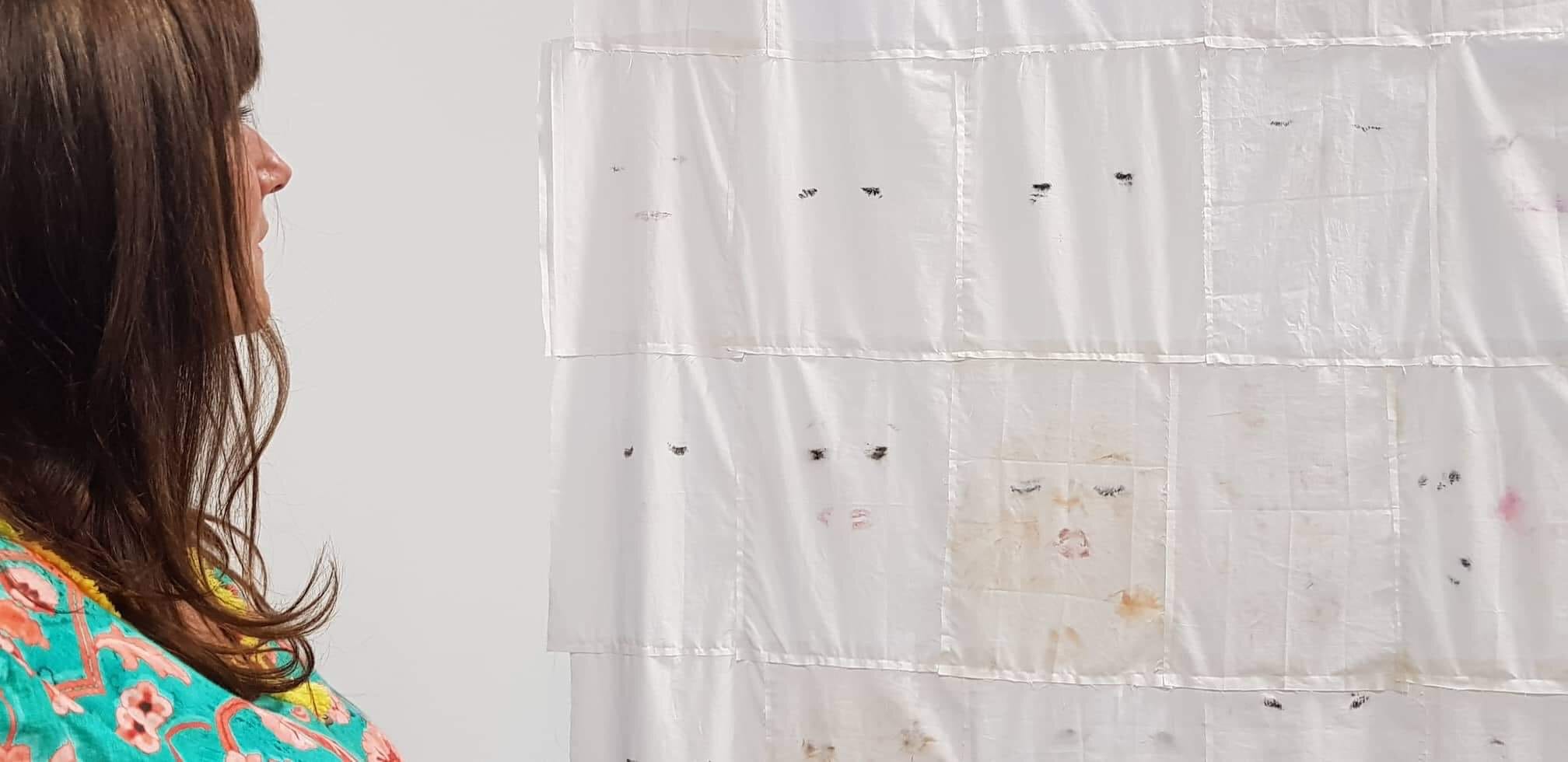
I say a little prayer for you; responses, performance and installation, 2019. Many thanks to Victoria Hollings for photography.
Case Study: I say a little prayer for you
Designing Conditions - I say a little prayer for you; gathering material
I say a little prayer for you was structured through a simple invitation: participants were asked to create self-portraits by pressing cloth against their faces to capture traces of makeup, and to return these via post. The project provided minimal instructions, materials, and a timeframe, but did not define outcomes.
Rather than specifying what the work would become, I established enabling conditions:
an open-ended protocol
distributed participation
voluntary engagement
space for narrative response
The project entered the complex domain immediately. Participation could not be guaranteed, responses could not be predicted, and the meaning of the work was not predetermined.
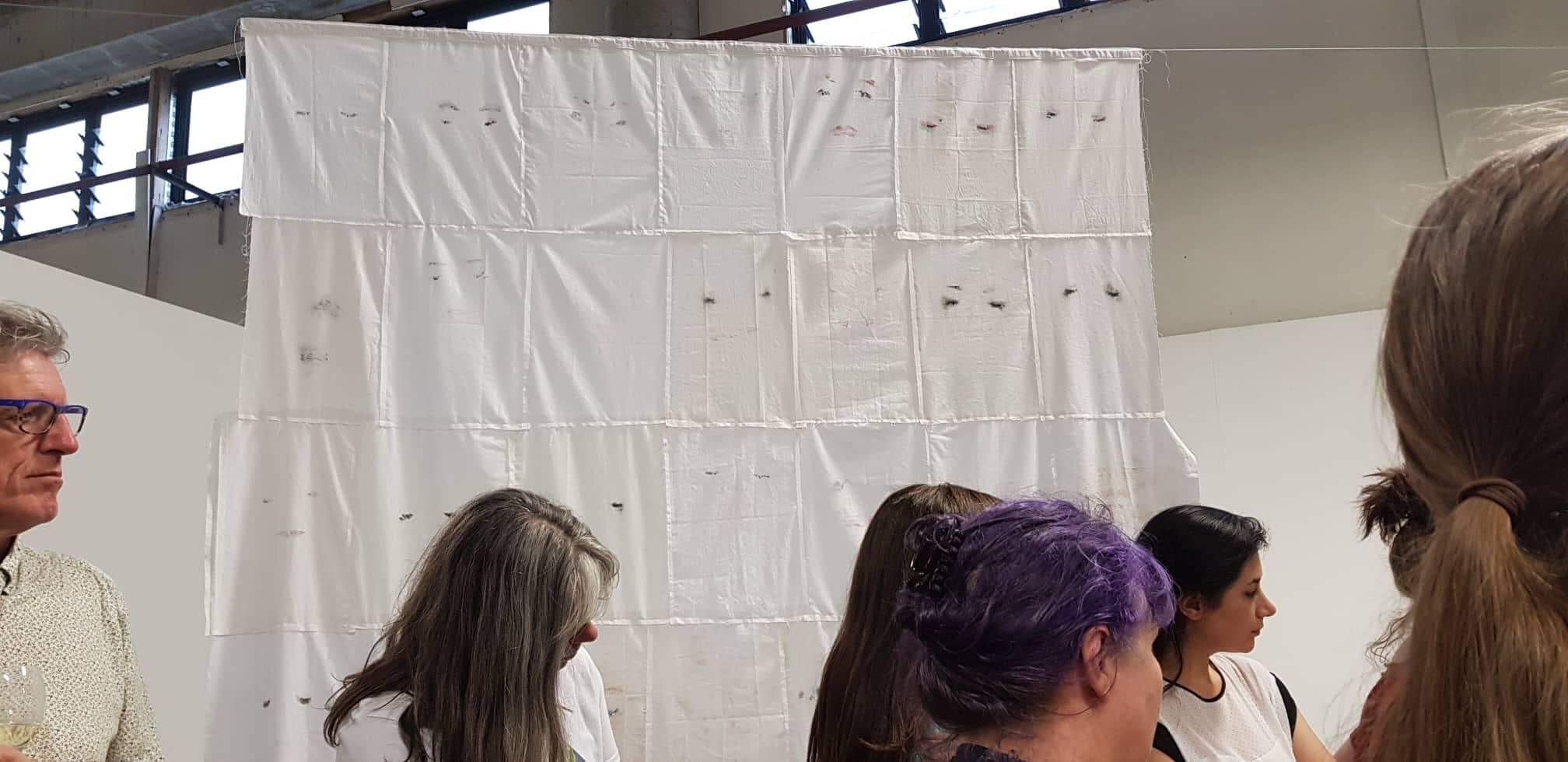
I say a little prayer for you; responses, performance and installation, 2019. Many thanks to Victoria Hollings for photography.
Holding Complexity
I say a little prayer for you; correspondence
As the project developed, my role shifted from initiating conditions to holding the system in motion. Participants contributed not only material artefacts, but personal stories and reflections. This was unexpected, but on reflection, made sense. These introduced emotional, social, and political dimensions that required careful navigation. It also revealed the location where meaning was most salient, it was stories not the object that was important.
A key challenge was managing proximity: how to engage deeply personal material while maintaining enough distance for the work to remain collectively held. Inviting others into the project redistributed authorship and reduced the intensity of a single narrative, while expanding the scope of the work.
This required ongoing adjustment:
stepping forward and back as needed
holding multiple perspectives simultaneously
resisting premature resolution
Structural decisions supported this approach. For example, assembling the works in the order they were received removed curatorial hierarchy and allowed the system to organise itself. Simple rules replaced subjective control.
Circulating and Scaling
I say a little prayer for you; responses
The work extended across multiple contexts:
private domestic spaces where portraits were created
material forms such as textiles and books
public performances
radio broadcast and podcast
Each context reshaped the work. Rather than fixing meaning, I allowed it to translate across these environments. The shift from visual to auditory modes foregrounded voice and narrative, repositioning attention from object to experience.
Importantly, the system scaled without centralisation. Contributions remained distinct, and participants’ voices were not standardised. The work expanded through distribution rather than consolidation.
As the project evolved, questions of authorship became central. While participation was distributed, accountability remained with me. By naming the work as mine, I assumed responsibility for:
the relationships established
the conditions of participation
the use and representation of contributions
This responsibility was grounded in trust. Participants shared personal experiences under conditions of anonymity, creating an obligation to steward the work with care.
My role became one of:
facilitator
curator
integrator
conduit
This reflects a form of relational governance, where leadership is not exercised through control, but through responsibility for the system’s integrity.
Completing Without Closure
In the final phase, the work shifted into sensemaking. Rather than generating new material, I focused on listening and re-presenting what had emerged. Stories were shared through broadcast, allowing them to circulate while remaining unresolved.
The work still resists closure. Contradictions are maintained, and multiple perspectives remain visible. My role becomes one of witnessing and holding, recognising when not to intervene.
This highlights a critical aspect of working with complexity: the capacity to allow systems to stabilise without forcing resolution.
Implications for Leadership Practice
This project demonstrates a set of capabilities directly applicable to leadership in complex environments:
Designing conditions rather than directing outcomes
Holding uncertainty without premature resolution
Distributing agency while retaining accountability
Maintaining coherence across multiple contexts
Building and sustaining trust as system infrastructure
Recognising when to intervene and when to step back
These are not abstract principles. They are operational practices developed through experience.
Conclusion
What I developed through my MFA practice was not only an artistic methodology, but a way of working that translates directly into leadership under complexity.
Across this project, my role shifted:
from initiating conditions
to holding complexity
to circulating meaning
to stewarding relationships
to witnessing without closure
This reflects a broader shift required of leaders today.
In complex environments, leadership is not defined by the ability to make decisions or control outcomes. It is defined by the ability to create conditions, sustain systems, and hold uncertainty productively.
The move is from decision-maker to condition-setter, and ultimately to steward of a system that cannot be fully controlled.
My arts practice did not anticipate complexity leadership theory. It provided a lived methodology for working within it.
“Imaginative thinking, the key to creative problem-solving, consists in combining existing ideas, information and materials in new ways…To solve a problem creatively it is not necessary to finish up with a functional working model.” - 1978 Ministry of Education, Art in Schools; The New Zealand Experience.
References
Bourriaud, N. (1998). Relational aesthetics. Les presses du réel.
Corballis, T. (2018). Mata Aho: Mana wāhine in contemporary art. Art New Zealand, (165), 69–78.
Friedman, K. (Ed.). (1998). The Fluxus reader. Academy Editions.
Higgins, H. (2002). Fluxus experience. University of California Press.
Lander, M. (n.d.). Flat-Pack Whakapapa. Govett-Brewster Art Gallery. https://govettbrewster.com/exhibitions/maureen-lander-flat-pack-whakapapa
Ministry of Education. (1978). Art in schools: The New Zealand experience. Wellington, New Zealand.
Oda Projesi. (n.d.). Oda Projesi. Tabakalera.
Snowden, D. J., & Boone, M. E. (2007). A leader’s framework for decision making. Harvard Business Review, 85(11), 68–76.
Uhl-Bien, M., Marion, R., & McKelvey, B. (2007). Complexity leadership theory: Shifting leadership from the industrial age to the knowledge era. The Leadership Quarterly, 18(4), 298–318.
Walker, J. S. (2009). The body is present even if in disguise: Tracing the trace in the artwork of Nancy Spero and Ana Mendieta. Tate Papers, (11). http://www.tate.org.uk/research/publications/tate-papers/11/the-body-is-present-even-if-in-disguise-tracing-the-trace-in-the-artwork-of-nancy-spero-and-ana-mendieta